Some construction work remains visible after completion.
Other work disappears behind plasterboard, screed, ceilings, cladding or concrete — sometimes only hours after it is installed.
Before that happens, the actual installation may be available for direct inspection.
Afterwards, the question changes from:
Does this work meet the requirement?
to:
What can we still demonstrate about work that nobody can see anymore?
Photographs, measurements, checklists and test results may help.
But they cannot automatically recreate an inspection opportunity that has already been lost.
1. The problem
Imagine an external wall before the plasterboard is installed.
While it is open, the contractor or reviewer may be able to check:
- insulation type and thickness;
- continuity;
- gaps and compression;
- airtightness membranes;
- tapes and seals;
- service penetrations;
- window junctions;
- fixings;
- difficult corners and interfaces.
Then the wall is closed.
Most of those details disappear.
If somebody asks three months later:
“Was the insulation installed correctly?”
there may be photographs, delivery notes and a completed checklist.
Those records can be valuable.
But they do not automatically demonstrate everything that could have been inspected while the wall was open.
The original condition is no longer directly accessible.
That is the core problem with hidden work.
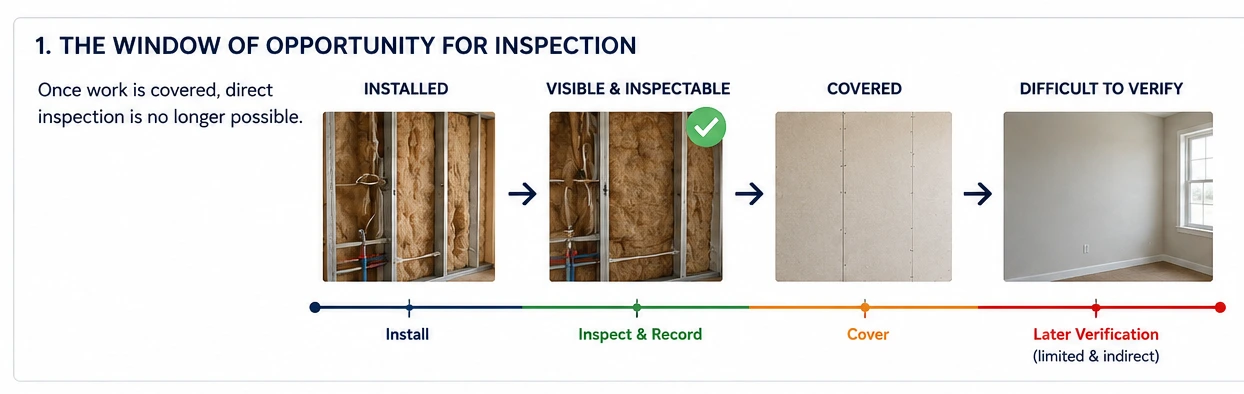
2. Timing is part of quality control
For concealed work, quality control is not only about what should be checked.
It is also about when the check must happen.
A typical sequence is:
Installed → Visible → Inspectable → Covered → Difficult to verify
This matters for work such as:
- insulation;
- airtightness layers;
- fire stopping;
- reinforcement before concrete;
- waterproofing;
- cavity barriers;
- concealed pipework;
- structural fixings;
- façade anchors;
- window perimeter sealing.
The important question is:
What will become difficult, expensive or impossible to check later?
The greater the consequence of failure — and the harder later access will be — the stronger the case for checking the work before concealment.
3. Plan the inspection before the following trade arrives
A common site problem is not lack of knowledge.
It is sequencing.
The insulation installer finishes today.
The plasterboard team starts tomorrow.
The supervisor assumes somebody else has checked the wall.
The reviewer was never notified.
By the time the mistake is discovered, the work is already concealed.
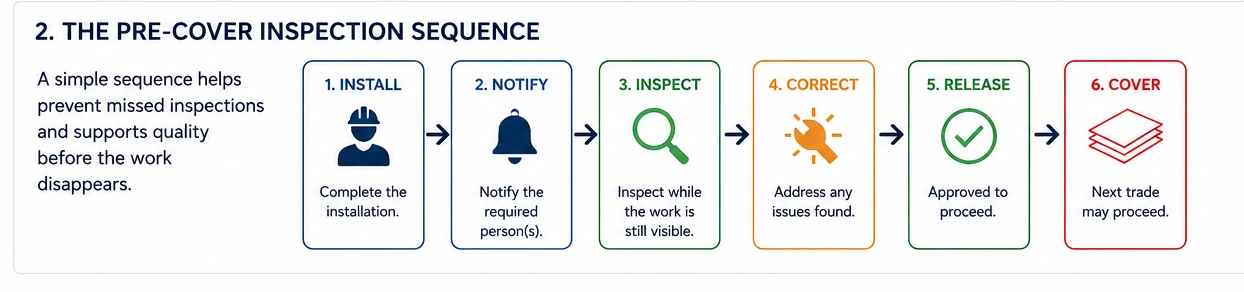
A practical sequence is therefore:
Install → Notify → Inspect → Correct if required → Release → Cover
The exact control depends on the project.
Some activities may require a formal hold point.
Others may use a witness point, routine supervisor inspection or contractor self-check.
Not every concealed activity needs an external inspector.
What matters is that the team knows in advance:
- what must be checked;
- when it must still be visible;
- who performs the check;
- whether anyone must be notified;
- what evidence is required;
- what allows the next stage to proceed;
- what happens if the check fails.
A useful inspection point must fit the construction sequence, not fight against it.
4. Capture evidence that supports the actual check
The objective is not to photograph everything.
It is to preserve evidence relevant to the requirement.
For example, instead of:
Take photographs of insulation
a useful inspection requirement might be:
Confirm the specified insulation type, required thickness, continuity and treatment around penetrations before closure.
The record may then contain:
Location
Which wall, room, window, zone or installation?
Requirement or criterion
What was being checked?
Overview evidence
Can the inspected area be identified in context?
Detail evidence
Can the relevant installation feature actually be seen?
Measurement
Was thickness, spacing, depth or another criterion measured where required?
Product identification
Can the relevant material or system be identified?
Result
What was concluded from the inspection?
The useful record is not simply:
Photograph + timestamp.
It is the connection between:
location + requirement + visible condition + evidence + conclusion
5. Coverage matters
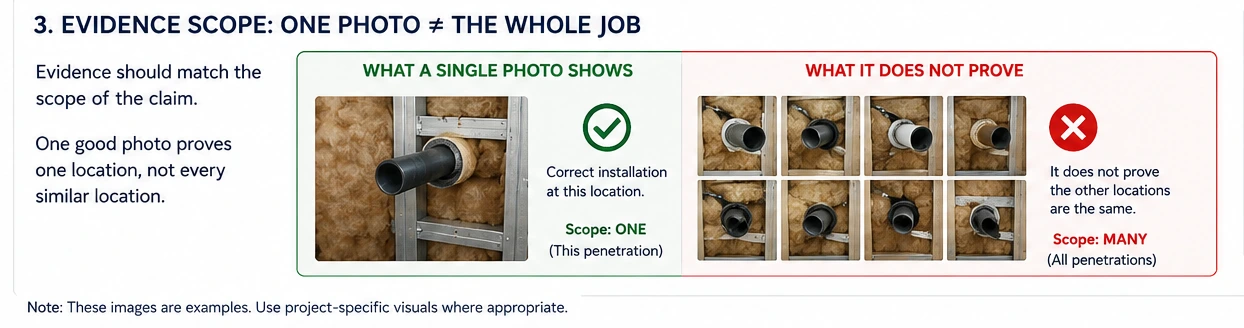
Suppose a building contains 80 fire-stopping penetrations.
One excellent photograph shows that one penetration was correctly installed.
That is useful evidence for that location.
It does not automatically prove the other 79.
The same principle applies elsewhere:
one insulation bay ≠ the whole façade;
one window ≠ every window;
one fixing ≠ all fixings;
one bathroom ≠ every bathroom.
The inspection strategy may require:
- every item to be checked;
- defined sampling;
- checks by zone;
- checks by work package;
- specialist testing;
- or a combination.
There is no universal rule that every concealed item must be photographed individually.
But the scope of the claim should match the scope of the evidence.
Good evidence makes clear not only what it shows, but also what it does not show.
6. What happens if the inspection opportunity is missed?
This is where records can become misleading.
Suppose the insulation was supposed to be inspected before plasterboard installation.
The wall was closed first.
Later, somebody finds several photographs taken by the installer.
Those photographs may still be useful.
There may also be:
- delivery records;
- measurements;
- supervisor notes;
- commissioning data;
- test results.
But the project should not create a retrospective record suggesting that the planned pre-cover inspection took place.
A better record would say:
Required:
Pre-cover inspection of insulation continuity.

Actual:
Wall closed before planned inspection.

Available evidence:
Installer photographs from installation.
Material records.
Recorded thickness measurements.

Alternative verification:
Review of contemporaneous evidence.

Limitation:
Full continuity of the concealed installation
was not directly inspected.
That may look less reassuring than:
Insulation — OK.
But it is much more useful if the project is later questioned.
7. Alternative verification can help — but it answers different questions
Missing the original inspection does not always mean that verification is impossible.
Depending on the work, alternatives may include:
- opening-up;
- borescope inspection;
- additional measurements;
- non-destructive testing;
- thermal imaging;
- airtightness testing;
- pressure testing;
- specialist assessment;
- commissioning results;
- contemporaneous photographs or video.
But those methods have different strengths.
A whole-building airtightness test may provide strong evidence of overall envelope performance.
It does not necessarily prove that every concealed junction was constructed exactly as detailed.
Thermal imaging may identify suspicious areas.
It does not automatically reveal the complete hidden construction.
An opening-up inspection provides direct evidence at the opened location.
It does not automatically prove identical conditions elsewhere.
Alternative verification should therefore be recorded for what it actually demonstrates — not presented as though the original inspection took place.
8. If something is wrong, preserve the correction history
Suppose a pre-cover inspection identifies a gap in insulation around a service penetration.
The contractor corrects it.
The correct sequence is:
Inspection → Issue → Corrective Action → New Evidence → Reinspection → Evaluation → Release
The original failed condition should remain part of the record.
It should not be replaced by the corrected photograph as though nothing went wrong.
For the contractor, this shows that the issue was found and resolved.
For the client, it shows that the later decision related to the corrected condition.
A defect that was identified and properly corrected can demonstrate a functioning QA process.
A defect that disappears from the record does not.
9. Common mistakes
Typical weaknesses include:
- scheduling the inspection after concealment;
- failing to notify the responsible reviewer;
- allowing the following trade to proceed too early;
- taking close-up photographs with no identifiable location;
- failing to identify the applicable criterion;
- treating upload time as proof of capture time;
- using one photograph to support a much broader claim;
- treating a product certificate as proof of correct installation;
- treating a photograph as proof of technical evaluation;
- deleting failed evidence after correction;
- pretending a missed inspection happened retrospectively;
- collecting hundreds of photographs nobody meaningfully reviews;
- assuming a digital system makes weak evidence reliable.
The aim is not maximum documentation.
It is the right evidence at the right inspection moment.
10. How VerityHub helps
Hidden work illustrates why construction evidence needs context and traceability rather than simple file storage.
VerityHub can connect:
- Project;
- Requirement and Verification Criterion;
- Task or Item of Work;
- Asset, Zone and Location;
- Evidence;
- evidence scope;
- capture and submission information;
- Evaluation;
- Issue or Corrective Action;
- replacement or additional Evidence;
- re-evaluation;
- Approval;
- Handover;
- Audit history.
The broader verification chain remains:
Requirement → Task → Evidence → Evaluation → Issue or Corrective Action → Approval → Handover → Audit
The value is not that a photograph exists in the system.
The value is that a reviewer can understand:
What had to be checked?
Where did it apply?
Was the work still visible?
What evidence was captured?
What scope did that evidence cover?
What conclusion was reached?
Was anything corrected?
Which later decision relied on the corrected condition?
VerityHub can preserve that relationship and decision history. That is consistent with its role as a construction verification and traceability platform rather than a generic file repository.
But VerityHub cannot recreate information that was never captured.
It cannot determine what is behind a finished wall merely because a digital record exists.
And it cannot turn a photograph, certificate, checklist or signature into technical proof beyond what that evidence actually supports.
Key takeaway
For hidden work, timing is part of evidence quality.
Before work is covered, ask:
What will become difficult or impossible to verify afterwards?
Then make sure the important condition is:
Visible → Checked → Evidenced → Evaluated → Corrected if required → Released → Covered
The purpose is not to create more paperwork.
It is to avoid discovering at handover that the best opportunity to verify an important part of the building disappeared months earlier.
Next in the series
How Do You Prove a Construction Defect Was Really Fixed?
Identifying a defect is only the beginning.
The next article will look at the corrective-action loop: how to preserve the original problem, connect the repair to it, capture new evidence, reinspect the work and demonstrate that the corrected condition — rather than the failed one — was actually evaluated and accepted.