Some construction work can still be checked after completion.
Some cannot.
Once insulation is covered, membranes are closed, reinforcement is concreted over, fire stopping is boxed in or fixings disappear behind finishes, the opportunity to inspect the actual work may be lost.
That is why good construction QA asks not only:
“Was the work checked?”
but also:
“Was it checked while the critical details were still visible?”
1. The problem
Concealed-work problems are often discovered too late.
A wall has already been closed.
Concrete has already been poured.
A ceiling has already been installed.
A service penetration has disappeared behind a riser enclosure.
At that point, a reviewer may have only:
photographs;
a contractor's statement;
an inspection sheet;
or records created after the work became inaccessible.
Those records may still be useful.
But they cannot automatically reproduce everything that could have been inspected while the work was open.
For concealed or safety-critical work, the inspection opportunity itself is part of quality control.
2. Why timing matters
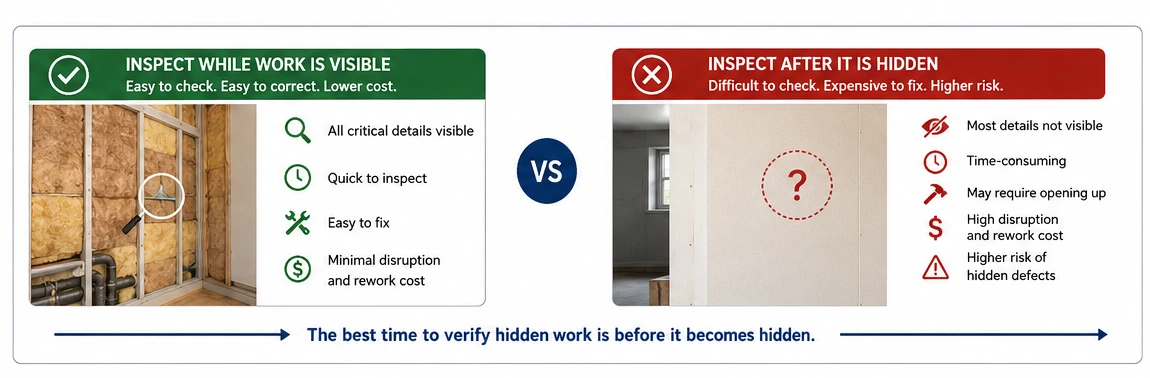
Consider an insulated external wall before plasterboard closure.
While it is still open, a supervisor or inspector may be able to check:
insulation type;
thickness;
continuity;
gaps or excessive compression;
junctions at floors and ceilings;
service penetrations;
airtightness membranes;
tapes and seals;
relevant fixing details.
After closure, most of those details are no longer directly visible.
The finished wall may look excellent while important defects remain behind it.
The same problem applies to:
fire stopping;
cavity barriers;
waterproofing;
structural reinforcement;
structural anchors;
concealed drainage;
window perimeter sealing;
mechanical and electrical services;
airtightness layers.
There is also a cost difference.
A defect identified while work is open may be corrected quickly.
Finding the same defect afterwards may require opening finished construction, damaging materials, interrupting following trades and creating substantial rework.
The stronger the consequence of failure — and the harder the work will be to inspect later — the more important the pre-cover inspection becomes.
3. Inspection points, witness points and hold points
Not every pre-cover check needs to stop the project.
A practical QA plan can use different levels of control.
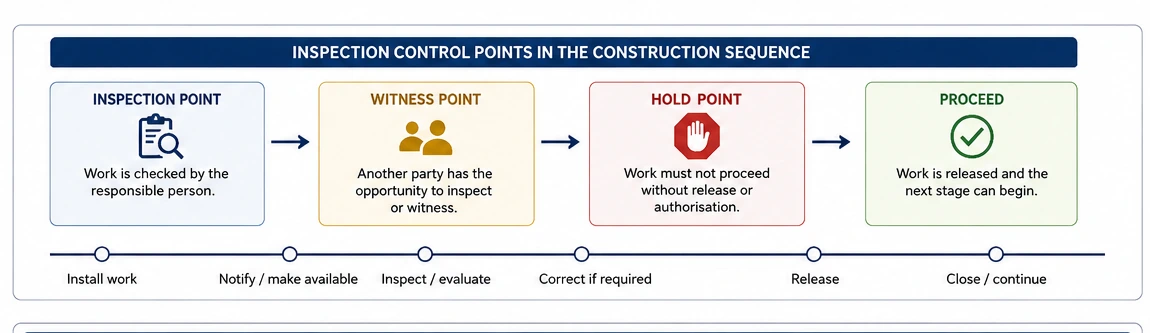
Inspection point
A defined stage where the work should be checked before proceeding.
Witness point
Another nominated party is given the opportunity to inspect or witness the work in accordance with the agreed procedure.
Hold point
Work must not proceed beyond the defined stage until the required release or authorisation has been obtained.
For example:
Install airtightness layer → notify reviewer → inspect → correct if required → release → close wall
The important part is that the inspection stage is agreed before construction reaches it.
The team should know:
what must remain visible;
what requirement or drawing applies;
what acceptance criteria will be used;
what evidence is expected;
who performs the check;
whether another party must be notified;
who can release the work;
and what happens if the work fails.
A useful checkpoint must also fit the construction programme.
If the inspector needs 24 hours' notice, that must be known before the following trade arrives to close the wall.
4. What should be recorded before closure?
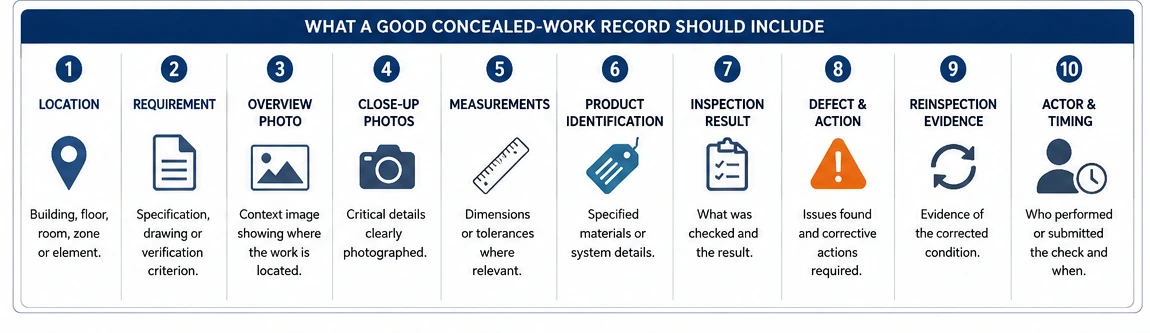
For important concealed work, a useful record may include:
Location — building, floor, room, zone or element.
Applicable requirement — specification, drawing or verification criterion.
Overview photograph — enough context to establish where the work is.
Close-up photographs — the critical details.
Measurements — where dimensions or tolerances matter.
Product identification — where the specified material or system matters.
Inspection result — what was actually checked and concluded.
Defect and corrective action — where something was wrong.
Reinspection evidence — showing the corrected condition.
Actor and timing — who performed or submitted the check and when.
For example:
Location: Level 2, electrical riser
Requirement: Fire-stopping detail FS-07
Work: Service penetration through compartment wall
Check: Correct system, opening size and installation detail
Evidence: Overview + close-up + product identification
Result: Pass / Fail / Needs Review
The aim is not to collect more photographs.
It is to preserve enough context to understand what was checked and against what criterion.
5. Coverage matters
One correctly inspected location does not automatically prove that the entire work package is correct.
The evidence should make clear whether it relates to:
one installation;
every repeated installation;
a defined sample;
one room or zone;
one façade;
or the complete system.
For example, one photograph of a correctly installed cavity barrier cannot by itself demonstrate that every cavity barrier in the building was installed correctly.
This matters particularly where the project uses sampling.
Good evidence should make the scope of the claim as clear as the evidence itself.
6. What happens when the work fails?
A failed inspection should start a controlled correction loop.
Inspection → Issue identified → Corrective action → New evidence → Reinspection → Evaluation
Suppose an airtightness membrane is damaged around a service penetration.
The record should preserve:
the original condition;
the defect identified;
the required corrective action;
the repaired condition;
the new evidence;
the reinspection;
and the resulting decision.
The earlier failed evidence should not disappear because the defect was repaired.
The history is valuable.
It shows not only the final condition, but also how the project responded when the work did not initially meet the requirement.
7. What if the inspection opportunity was missed?
Sometimes the work is already closed before the required check occurs.
In that situation, the project should not simply create a retrospective inspection record and pretend that the original check took place.
Alternative verification may sometimes be possible, for example:
opening-up inspections;
additional measurements;
non-destructive testing;
specialist assessment;
testing of completed performance;
review of contemporaneous site records.
But these alternatives have their own limitations.
The record should therefore distinguish:
planned pre-cover inspection
from:
alternative verification after the original inspection opportunity was missed
That distinction protects both the contractor and the client.
8. Common mistakes
Common problems include:
planning the inspection only after the work is complete;
failing to notify the reviewer in time;
allowing following trades to cover work before the agreed check;
using one photograph to represent a much larger scope;
taking close-ups without location context;
failing to identify the applicable criterion;
treating an uploaded photograph as equivalent to inspection;
correcting a defect without recording the new condition;
deleting or replacing failed evidence;
assuming the inspector also has authority to accept the work;
creating so many hold points that the site team begins bypassing the process.
The aim is not to stop construction constantly.
It is to identify a limited number of high-value moments where inspection is still possible and correction is still economical.
9. Inspection is not acceptance
Inspection, evaluation and approval are related, but they are not the same thing.
An installer may provide evidence.
A supervisor may inspect the installation.
A specialist may evaluate a test result.
A client's representative or another authorised party may later approve the outcome.
On smaller projects, one person may perform several of these functions.
But the functions remain different.
Inspection asks what was observed.
Evaluation asks whether it meets the criterion.
Approval records the authorised acceptance of the outcome.
A photograph, checklist or signature should not collapse those distinctions.
10. How VerityHub helps
VerityHub is designed to connect the inspection opportunity with the wider requirement-to-proof record.
For concealed work, the record can link:
the Project;
Requirement and Verification Criterion;
Task or Item of Work;
Asset, Zone or Location;
planned inspection stage;
Evidence;
Evaluation;
Issue or Corrective Action;
reinspection evidence;
Approval;
Handover;
Audit history.
The wider chain remains:
Requirement → Task → Evidence → Evaluation → Issue or Corrective Action → Approval → Handover → Audit
This can help a reviewer answer:
What needed to be checked before closure?
Where was the work?
Which criterion applied?
Was the evidence collected while the work was visible?
What part of the work did the evidence cover?
Who evaluated it?
Was a defect found?
What was corrected?
Was it reinspected?
Who authorised the outcome?
VerityHub cannot guarantee that every hidden defect was found.
It cannot replace competent inspection, suitable testing or professional judgement.
Its role is to make the required check, evidence, evaluation, correction and approval history easier to reconstruct before and after the work becomes inaccessible.
Key takeaway
For concealed work, evidence quality depends not only on what is collected but also on when it is collected.
A practical process asks:
What will become difficult or impossible to verify later?
Then it plans the right checkpoint before that opportunity disappears:
visible → inspected → evidenced → evaluated → corrected if necessary → released to proceed
Next in the series
Inspection Is Not Acceptance
The work has been inspected and the evidence appears satisfactory.
Does that mean it has been formally accepted?
The next article will examine the difference between inspection, evaluation and approval — and why those responsibilities should remain clear even on small construction projects.