Someone has inspected the work.
Does that mean it has been accepted?
Not necessarily.
Construction projects often involve several related but different decisions:
What was observed? → Does it meet the defined criterion? → Can work proceed? → Who is authorised to accept the outcome?
On a small project, one person may perform several of these functions.
But their meanings should still remain clear.
1. The problem
On site, quality decisions are often recorded in very simple language:
Checked — OK.
or:
Approved.
or even:
Looks good.
Months later, those words may create very different interpretations.
The contractor may understand:
The work was accepted.
The consultant may mean:
I inspected the visible detail and found no obvious problem.
The site manager may only mean:
You may proceed with the next stage.
And the person who signed the record may not have had authority to accept the work contractually at all.
The problem is therefore not necessarily that nobody checked the work.
It is that several different decisions have been compressed into one vague idea of sign-off.
If the answer is “not quickly”, then inspection happened — but acceptance may not be defensible.
2. Inspection, evaluation and acceptance are related — but different
The exact terminology varies between contracts and organisations.
What matters is understanding the function behind the decision.
Inspection
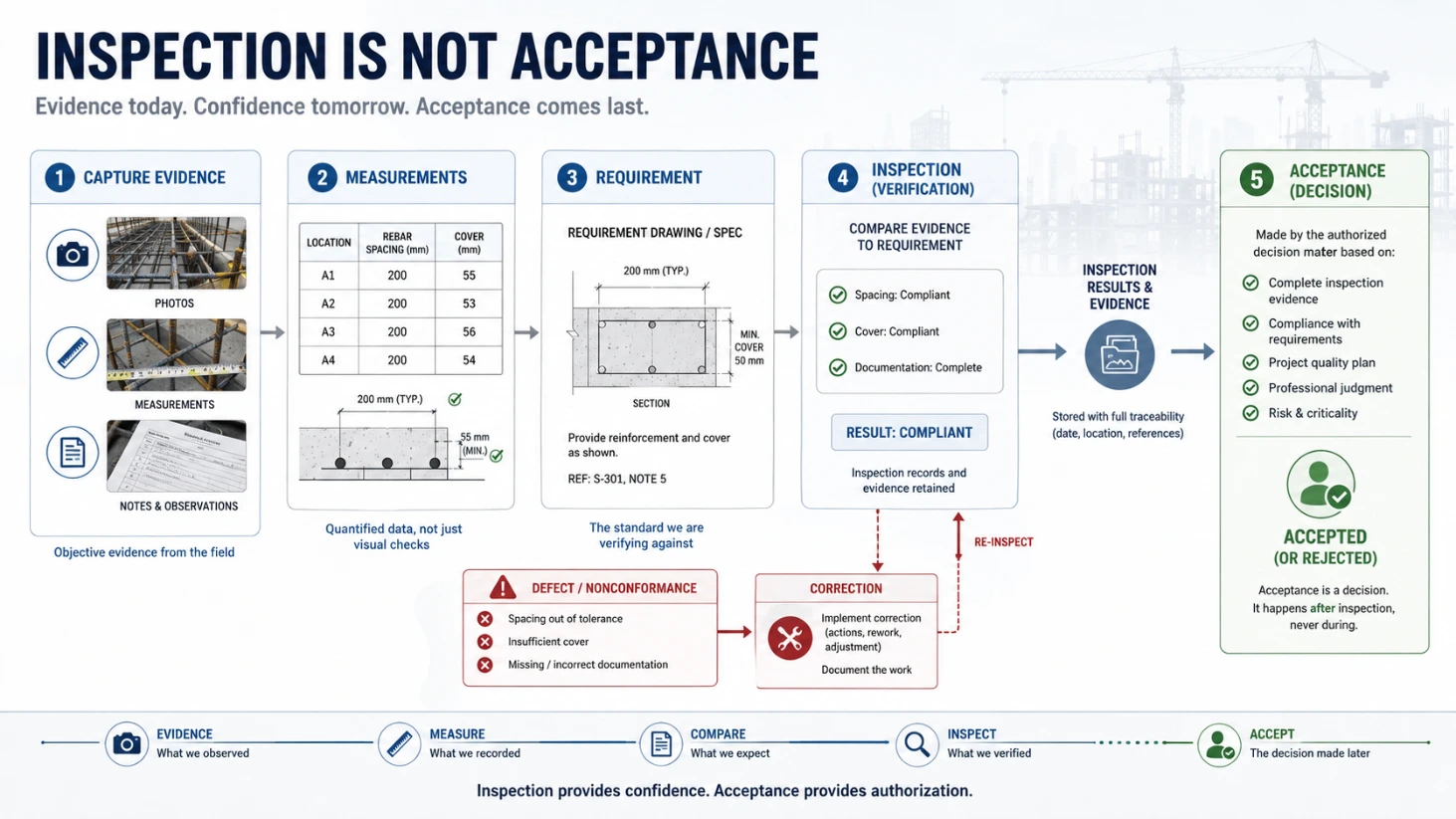
Inspection establishes what was observed or checked.
For example:
- insulation was visible before closure;
- the installed product was identified;
- fixing spacing was measured;
- a membrane junction was examined;
- a test was witnessed.
An inspection may also include an immediate technical judgement.
But a useful record should still make clear:
What was observed, and against what was it judged?
Evaluation
Evaluation asks whether the available evidence supports a conclusion against a defined criterion.
For example:
Required insulation thickness: 120 mm
Permitted tolerance: ±5 mm
Measured thickness: 118 mm
Evaluation: Pass
The important point is that 118 mm does not explain itself.
The decision only becomes meaningful when it is connected to the applicable requirement and tolerance.
Release to proceed
Construction also needs practical sequencing decisions.
After inspecting concealed work, someone may authorise:
Proceed with plasterboard closure.
That is an important decision.
But it does not automatically mean that the complete wall system, work package or contract scope has been finally accepted.
Approval or acceptance
A later decision may record that an authorised party accepts a defined outcome.
Who has that authority depends on:
- the contract;
- project procedures;
- delegated responsibilities;
- statutory requirements;
- certification arrangements.
There is no universal rule that the client, architect or inspector always performs this function.
The important question is not the job title. It is what authority the person actually has for that decision.
3. A practical example
Consider fire stopping around a service penetration.
Before the riser is closed, a site supervisor records:
- the exact location;
- overview photographs;
- close-up photographs;
- product identification;
- opening dimensions;
- installed condition.
That answers:
What was inspected?
The installation is then compared with the applicable fire-stopping detail and acceptance criteria.
That answers:
Does the evidence support a satisfactory technical conclusion?
If the result is satisfactory, the work may then be released for enclosure.
That answers:
May construction proceed?
Depending on the project, a later approval or acceptance decision may still be required for the relevant work package.
That answers:
Has the authorised party accepted this defined outcome?
These steps might all happen within minutes.
They might even be performed by the same person.
But they are not automatically the same decision.
4. Why the distinction matters
Inspection does not define the scope of acceptance
Inspecting one penetration does not automatically accept every penetration in the building.
Inspecting insulation before closure does not automatically accept the entire wall construction.
The record should state what the decision actually covers.
Evidence is not acceptance
A photograph, measurement, test report or checklist can support a decision.
Its existence does not demonstrate that somebody has evaluated or accepted the work.
Technical competence and authority can differ
A specialist may be competent to evaluate an airtightness result but have no contractual authority to accept the whole work package.
An authorised project representative may have authority to approve an outcome while relying on technical judgement provided by another specialist.
A signature needs context
A signature proves that someone signed a record.
It does not automatically tell us:
- what they reviewed;
- what criterion applied;
- what scope was covered;
- which evidence version they saw;
- whether the approval was conditional;
- or what authority they had.
The meaning behind the signature matters more than the signature itself.
5. A clear record does not need to be complicated
For important work, the record should make the decision chain understandable.
A practical structure is:
Requirement → Evidence → Inspection/Evaluation → Issue if required → Release or Approval
For example:
Location:
Level 2, Room 204

Requirement:
Window perimeter detail W-14

Evidence:
Overview photograph
Close-up photographs
Sealant depth measurement
Product identification

Evaluation:
Pass

Scope:
Window W204-03 only

Release:
Approved for internal finish installation

Final work-package acceptance:
Not yet recorded
That small distinction prevents a large amount of ambiguity.
6. What happens when the work does not pass?
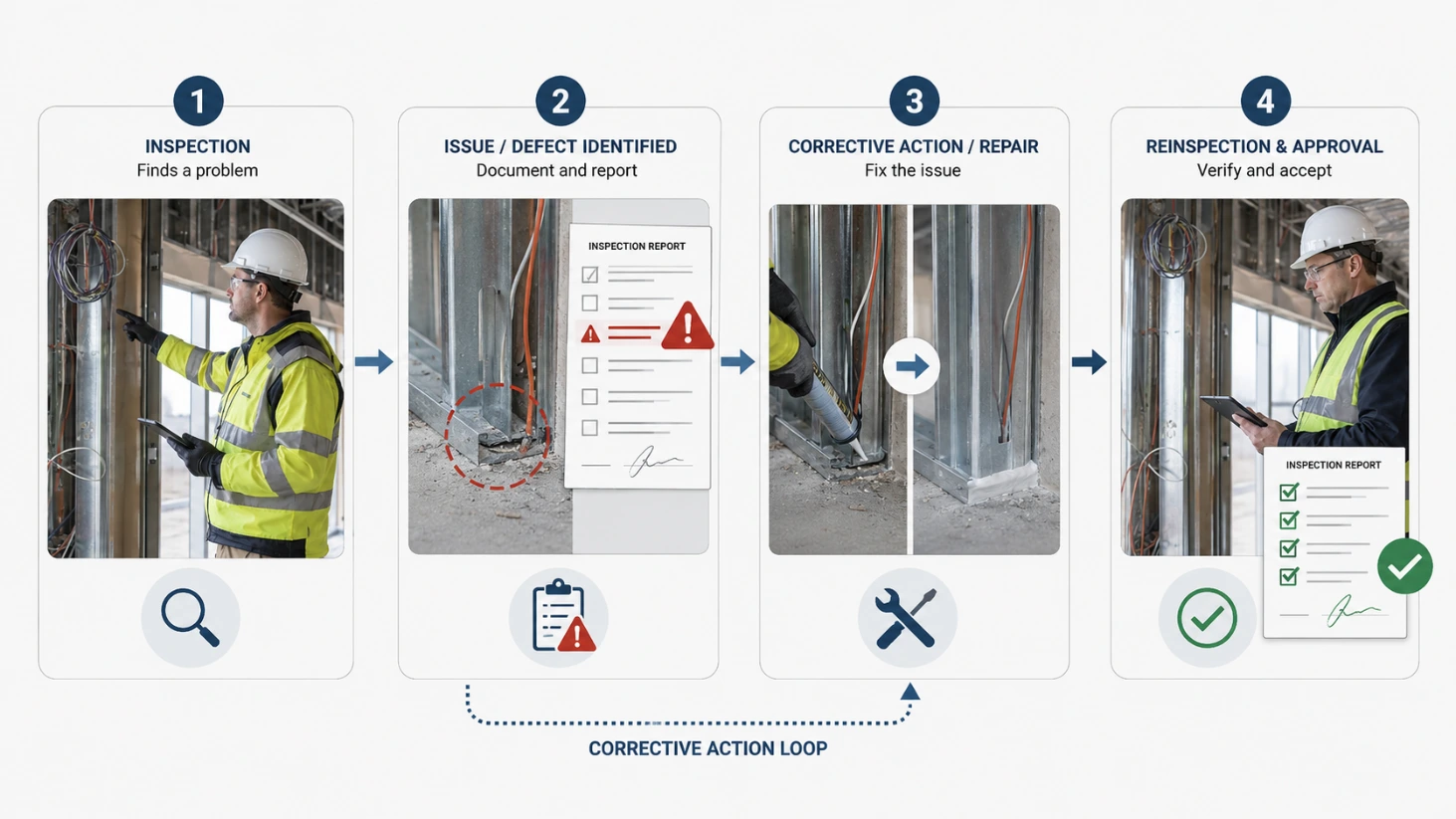
Inspection does not always lead directly to approval.
Suppose an airtightness membrane is incomplete around a window frame.
The sequence may become:
Inspection → Evaluation: Fail → Issue → Corrective Action → New Evidence → Reinspection → Re-evaluation → Release / Approval
The original failed evidence should remain available.
It should not disappear simply because the defect was corrected.
That protects both parties.
For the contractor, the record demonstrates:
The issue was identified and corrected.
For the client, it demonstrates:
The later decision related to the corrected condition, not the earlier defective one.
7. Competence and authority are different
A reliable quality process asks two separate questions.
Is this person competent to make the technical judgement?
and:
Is this person authorised to make this particular decision?
Sometimes the answer is the same person.
Sometimes it is not.
On a small project, a competent site manager may inspect, evaluate and release work themselves.
On a larger or specialist project, the sequence may involve:
Installer → Site supervisor → Specialist → Client representative
The aim is not to create unnecessary roles.
It is to make clear which function somebody is performing when they make a decision.
8. Common mistakes
Typical problems include:
- using inspection, approval, acceptance and sign-off interchangeably;
- interpreting a site visit as acceptance of the whole work package;
- treating a photograph or checklist as approval;
- recording Pass without identifying the criterion;
- approving more scope than was actually inspected;
- failing to distinguish release for the next construction stage from final acceptance;
- allowing unresolved issues to disappear behind an overall Approved status;
- approving a later evidence version without identifying which version was reviewed;
- deleting failed evidence after corrective work;
- relying on a signature without defining its meaning;
- assuming software status creates contractual, regulatory or technical acceptance.
The objective is not more bureaucracy.
It is fewer ambiguous decisions.
9. How VerityHub helps
VerityHub is designed to keep the underlying verification decisions traceable rather than reducing everything to a generic Approved status.
The record can connect:
- Project;
- Requirement and Verification Criterion;
- Task or Item of Work;
- Asset, Zone or Location;
- Evidence and evidence version;
- evaluator;
- Evaluation;
- Issue or Corrective Action;
- new evidence following correction;
- approver;
- Approval;
- Handover;
- Audit history.
The wider chain remains:
Requirement → Task → Evidence → Evaluation → Issue or Corrective Action → Approval → Handover → Audit
This allows a reviewer to distinguish:
What was inspected
from:
What technical conclusion was reached
from:
What scope was approved and by whom
VerityHub's product model deliberately keeps Evaluation and Approval distinct instead of treating them as generic workflow states.
It can also preserve the evidence and decision history so that later reviewers can reconstruct which condition was actually evaluated.
But VerityHub cannot:
- make weak evidence technically sufficient;
- determine professional competence by itself;
- grant contractual authority that the project has not granted;
- turn a digital signature into proof of compliance;
- or guarantee that every defect was discovered.
Its role is to make the basis, scope and history of the decision visible and traceable.
Key takeaway
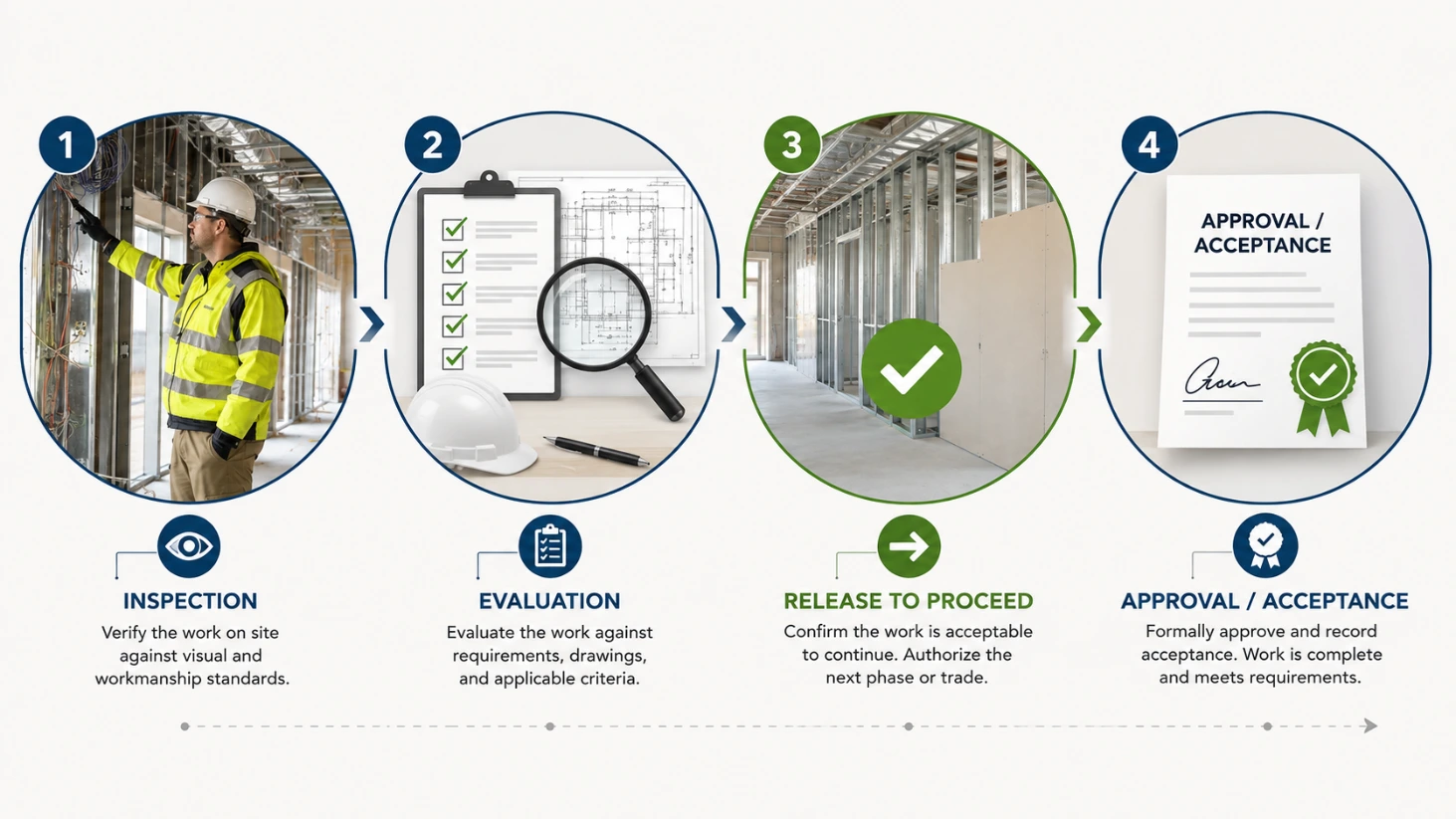
Inspection, evaluation, release and acceptance answer different questions:
Inspection: What was observed?
Evaluation: Does the evidence satisfy the criterion?
Release: May the next stage proceed?
Approval / acceptance: Has an authorised party accepted this defined outcome?
They may happen together.
They may even be performed by the same person.
But they should not become one ambiguous “signed off” status.
That clarity protects the contractor, protects the client and creates a much stronger record for handover and later review.
Where does this chain most often break in your projects?
Leave a comment or send us a short example. We are collecting real-world evidence gaps from contractors, consultants, architects, and retrofit teams to improve the VerityHub proof-chain model.
Next in the series
Hidden Work: Once It's Covered, Your Proof Disappears
Pre-cover inspection helps preserve evidence while work remains visible.
But what happens when that opportunity has already gone?
The next article will look at hidden work and retrospective verification: what later photographs, testing or opening-up can establish, what they cannot recreate, and why the original inspection opportunity sometimes cannot be replaced.