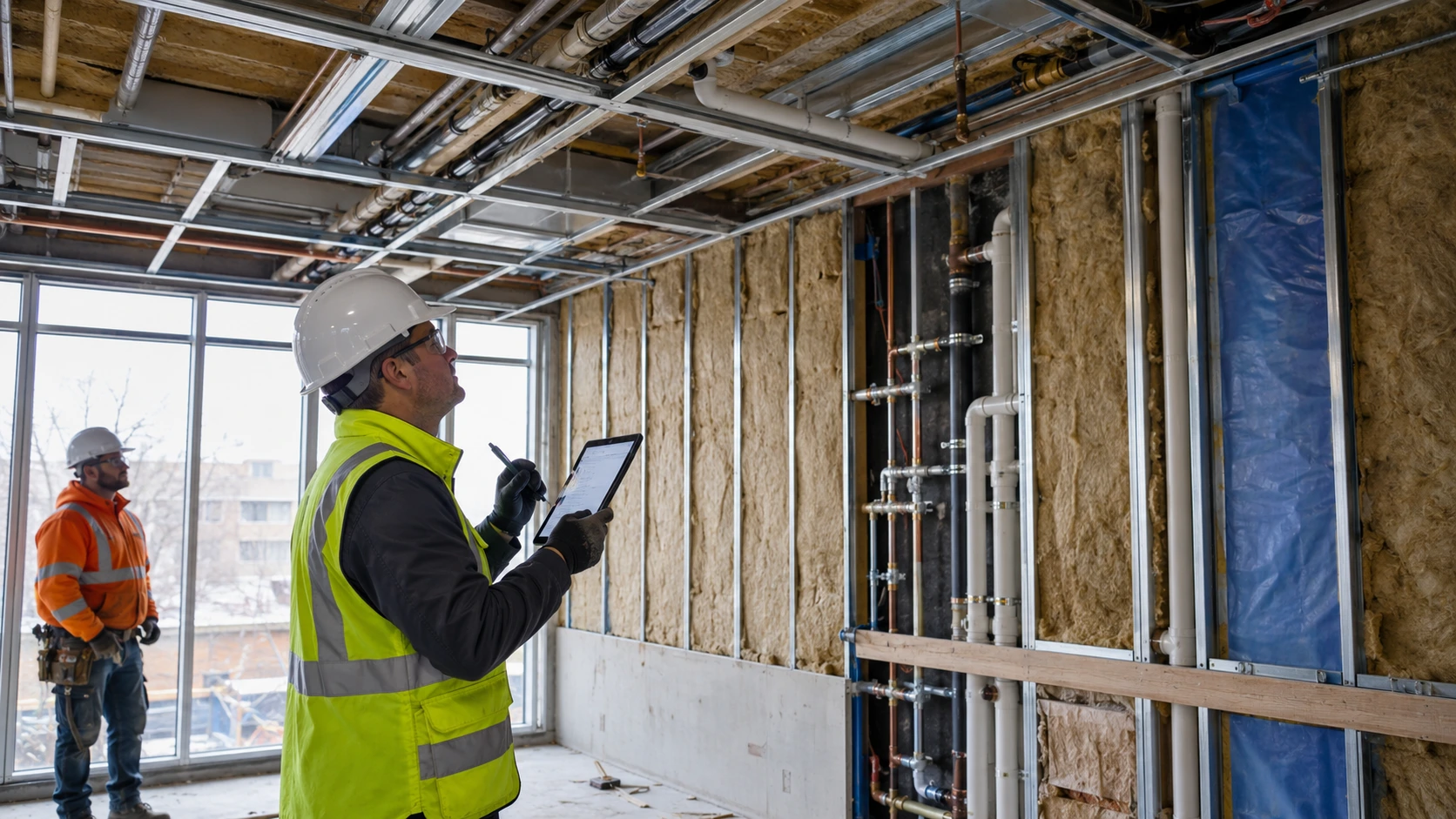
Construction evidence can take many forms: photographs, measurements, certificates, inspection records, test reports, product data and commissioning results.
But more evidence does not automatically mean better evidence.
For evidence to support a construction-quality decision, a reviewer must be able to understand:
What does this evidence relate to, where did it come from, what part of the work does it cover, and is it sufficient for the decision being made?
That requires more than storing a file.
1. The problem
Construction projects often contain plenty of information but weak connections between it.
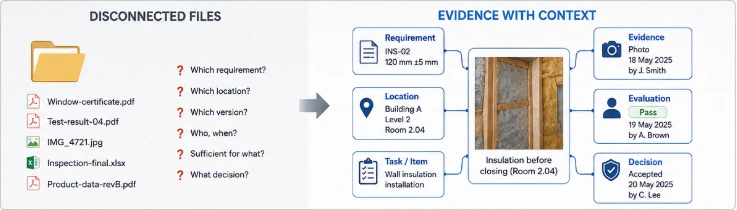
A project folder may contain:
Window-certificate.pdf
Test-result-04.pdf
IMG_4721.jpg
Inspection-final.xlsx
Product-data-revB.pdf
Every file may be genuine and useful.
But several months later, a contractor, consultant or client may still struggle to determine:
which requirement the evidence relates to;
which building element or location it covers;
which drawing or specification version applied;
who produced, captured or submitted it;
when the inspection or test took place;
whether it represents the whole scope or only one sample;
whether it was sufficient for the required check;
and what decision was eventually made.
The problem is therefore not simply missing documents.
It is missing evidential context.
2. A practical site example
Consider insulation that will soon be covered by plasterboard.
A contractor takes a clear photograph showing insulation between timber studs.
That photograph may be useful, but on its own it leaves important questions unanswered:
Which room or wall is shown?
What insulation specification applies?
What thickness was required?
Does the photograph represent one small area or the complete installation?
Was the photograph taken before the wall was closed?
Were difficult junctions and penetrations checked separately?
Who reviewed the work?
A stronger record might connect:
Requirement → Wall or room → Installation task → Photograph → Product / thickness information → Reviewer → Evaluation
This does not mean that every progress photograph needs a formal QA process.
The level of evidence should be proportionate to the claim being made.
The harder or more expensive the work will be to inspect later, and the greater the consequence of failure, the stronger the evidence record should be.
3. What makes evidence reliable?
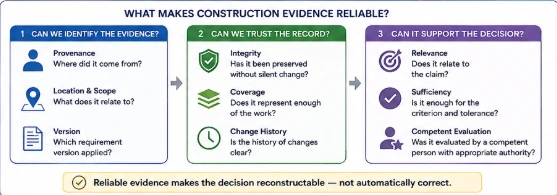
Instead of treating reliability as one property, it is useful to ask three groups of questions.
Can we identify the evidence?
Provenance
Where did it come from?
Depending on the evidence type, this may include:
who captured or produced it;
who submitted it;
capture, inspection or test date;
submission date;
equipment or test method;
source organisation.
Provenance helps reconstruct the history of the evidence.
It does not prove that the underlying work is technically correct.
Location and scope
What exactly does the evidence relate to?
A useful location might identify:
Project → Building → Floor → Room → Element
For other work, the appropriate context may be a façade zone, roof area, apartment, service system, structural grid or BIM object.
Scope matters as much as location.
A photograph of one correctly installed window does not establish that another 150 windows were installed in the same way.
Evidence can therefore be reliable for the item it records while still being insufficient to support a claim about the wider work package.
Version
Which requirement, drawing or specification applied?
Construction information changes.
Drawings are revised. Products are substituted. Requirements are amended. Corrective work creates new evidence.
A reviewer therefore needs to know:
Which version of the requirement was this evidence intended to satisfy?
Evidence evaluated against an obsolete drawing may be perfectly traceable and still support the wrong conclusion.
4. Can we trust the record itself?
Integrity
Where practical, the original submitted evidence should be preserved.
If a photograph is:
cropped;
annotated;
corrected;
replaced;
converted;
or supplemented,
the relationship with the earlier record should remain clear.
File hashes, timestamps and audit records can help show whether a stored file has been silently changed. But those controls solve only an integrity problem.
A hash can demonstrate that a file has not changed since it was recorded.
It cannot prove that:
the photograph shows the correct location;
the description is truthful;
the measurement was performed correctly;
or the work complies with the requirement.
Coverage
Evidence should also represent enough of the work.
This is particularly important when verification is based on sampling.
For example:
one photograph may represent one fire-stopping penetration;
several inspections may represent a sample of repeated installations;
a commissioning report may cover an entire system;
a certificate may apply to a product type but not prove installation quality.
The evidence record should make the extent of the claim clear.
5. Can the evidence actually support the decision?
Relevance
Evidence must support a specific claim.
A manufacturer's certificate may be authentic but irrelevant if it cannot be connected to the product actually installed.
A measurement may be accurate but useless if nobody knows which criterion it was intended to verify.
Sufficiency
Even perfectly traceable evidence may not be enough.
For example, suppose a requirement states:
Required insulation thickness: 120 mm
Permitted tolerance: ±5 mm
The recorded measurement is:
118 mm
The measurement can now be evaluated against something meaningful.
Without the requirement and tolerance, 118 mm is simply a number.
A useful general rule is:
Evidence can only be meaningfully evaluated when the applicable requirement, criterion, tolerance, method or acceptance condition is known.
Competent evaluation
Evidence and evaluation are different things.
The evidence supports the decision. It is not the decision.
Depending on the work, the evaluator may also need:
appropriate technical competence;
specialist qualification;
formal appointment;
sufficient independence;
or authority defined by the project.
An evaluator might conclude:
Pass;
Fail;
Needs Review;
Inconclusive;
or that additional evidence is required.
Formal acceptance may then still require another person with contractual or organisational authority.
Evaluation asks: does the evidence satisfy the criterion?
Approval asks: does the authorised party accept the outcome?
These should not be treated as the same event.
6. Common mistakes
Weak evidence records often result from simple practices:
storing certificates without linking them to the installed product;
recording measurements without the required value or tolerance;
losing the drawing or specification revision used during inspection;
replacing an earlier file without preserving its history;
mixing evidence from several locations into one generic folder;
using one photograph to support a claim about a much larger scope;
treating a submitted report as automatically accepted;
keeping a result while losing the underlying test information;
accepting evidence without identifying the criterion used for evaluation;
allowing the same person or system to blur evidence submission, evaluation and formal approval.
A digital audit trail can faithfully preserve a bad input.
If the wrong location, wrong requirement, wrong test method, wrong sample or wrong tolerance was used, perfect traceability will not make the resulting conclusion correct.
Traceability makes a decision reconstructable. It does not make the decision automatically right.
7. How VerityHub helps
VerityHub is designed to preserve the relationship between evidence and the decision it is intended to support.
Rather than treating a photograph, certificate, measurement or report as an isolated file, VerityHub can connect the evidence record to:
the Project;
Requirement and Verification Criterion;
Task or Item of Work;
Asset, Zone or Location;
evidence source and actor;
capture, test and submission information;
applicable requirement version;
integrity information;
Evaluation;
Issue or Corrective Action;
Approval;
Handover;
Audit history.
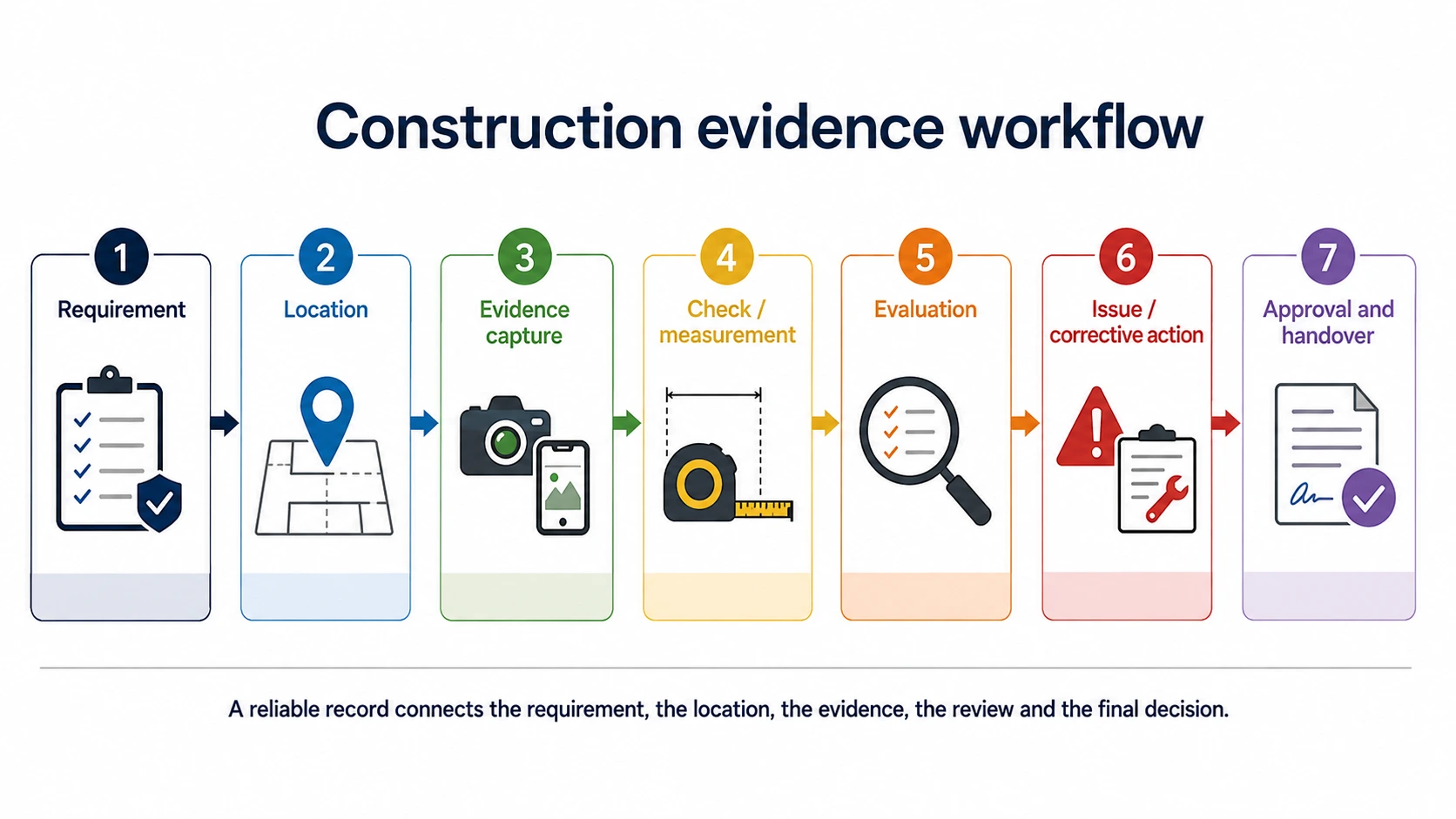
This supports the wider verification chain:
Requirement → Task → Evidence → Evaluation → Issue or Corrective Action → Approval → Handover → Audit
The important value is not the number of metadata fields.
It is the ability to preserve:
which requirement applied → which evidence was submitted → which version was reviewed → how it was evaluated → what was corrected → what was eventually approved
VerityHub's wider product direction deliberately treats evidence metadata and provenance, human Evaluation, Issues, Corrective Actions, Approval and Audit as separate parts of the verification chain rather than collapsing them into a generic document workflow.
VerityHub cannot independently guarantee that evidence is truthful, technically sufficient or legally compliant.
Nor does it replace:
competent inspection;
specialist testing;
certification;
professional judgement;
contractual authority;
or a regulator.
Its role is to make the evidence-to-decision chain structured, visible and traceable.
Key takeaway
Reliable construction evidence is not simply a photograph, certificate, measurement or report.
A useful record should help answer three questions:
Can we identify what this evidence relates to?
Can we trust the integrity and coverage of the record?
Is it sufficient to support this particular decision?
When those questions can be answered clearly, contractors can demonstrate their work more efficiently, reviewers can evaluate it more consistently, and clients can understand why an outcome was accepted.
Next in the series
How to Inspect Work Before It Becomes Hidden
Some construction quality can still be checked after completion.
Some cannot.
The next article will examine hold points, concealed work and evidence timing—and why the opportunity to create useful evidence may disappear as soon as the next layer of construction is installed.